Comet 3I/ATLAS
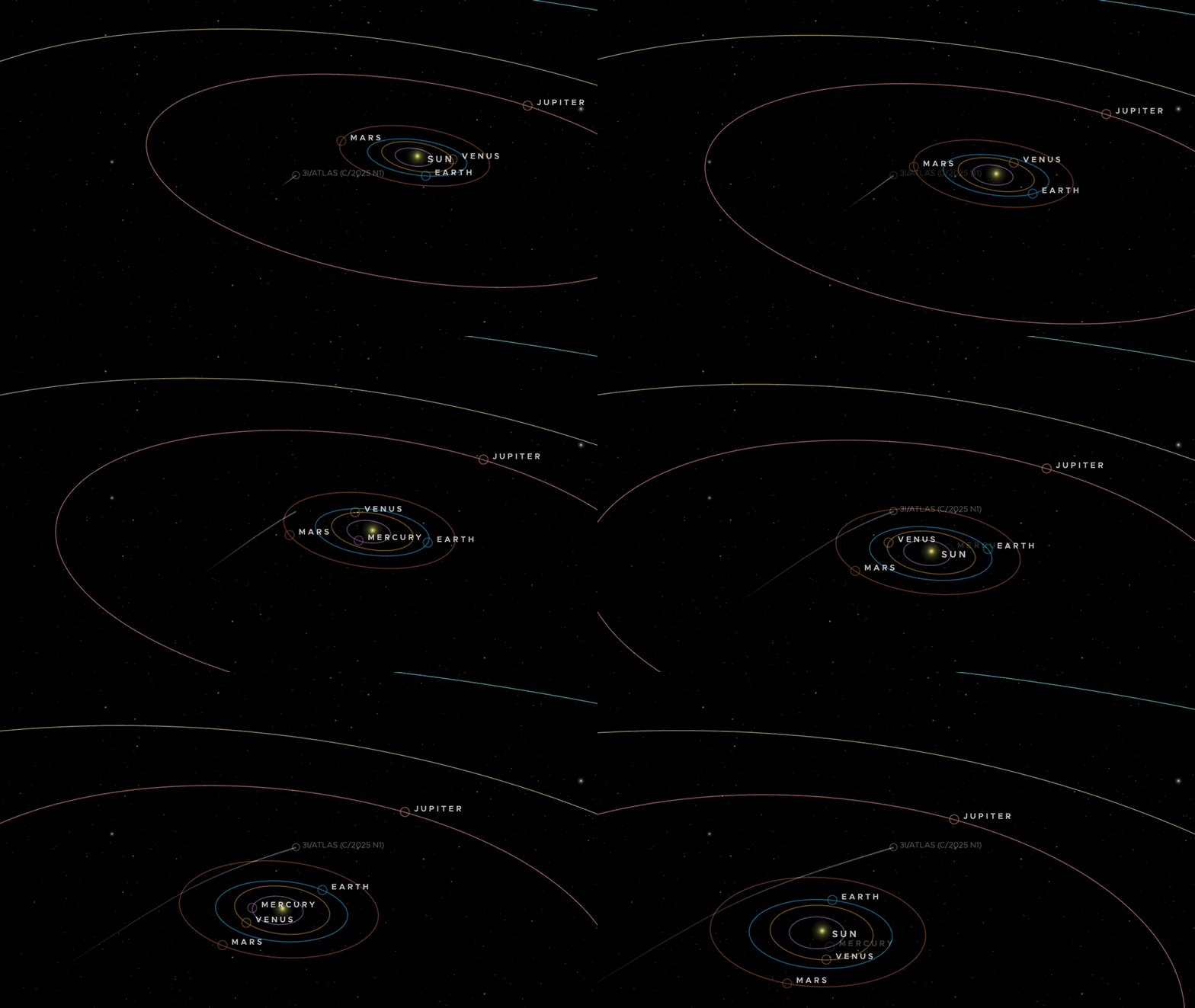
Comet 3I/ATLAS is the third known object from outside our solar system to be discovered passing through our celestial neighborhood. Astronomers have categorized this object as interstellar because of the hyperbolic shape of its orbital path. (It does not follow a closed orbital path about the Sun.) When the orbit of 3I/ATLAS is traced into the past, the comet clearly originates from outside our solar system.
Comet 3I/ATLAS poses no threat to Earth and will remain far away. The closest it will approach our planet is about 1.8 astronomical units (about 170 million miles, or 270 million kilometers). 3I/ATLAS will reach its closest point to the Sun around Oct. 30, 2025, at a distance of about 1.4 au (130 million miles, or 210 million kilometers) — just inside the orbit of Mars.
NASA Assets Observing Comet 3I/ATLAS
NASA's Hubble Space Telescope captured this image of interstellar comet 3I/ATLAS on July 21, 2025, when the comet was 277 million miles from Earth. Hubble revealed a teardrop-shaped cocoon of dust coming off of the comet's solid, icy nucleus. Because Hubble was tracking the comet moving along a hyperbolic trajectory, the stationary background stars are streaked in the exposure. Hubble’s continuing observations allow astronomers to more accurately estimate the size of the comet’s nucleus. Observations as of Aug. 20, 2025, indicate that the upper limit on its diameter is 3.5 miles (5.6 kilometers), though it could be as small as 1,444 feet (440 meters) across.
NASA assets that are planning to gather observations of 3I/ATLAS include: Hubble, Webb, TESS, Swift, SPHEREx, Perseverance Mars rover, Mars Reconnaissance Orbiter, Curiosity rover, Europa Clipper, Lucy, Psyche, Parker Solar Probe, PUNCH, and ESA/NASA’s SOHO and Juice.


Komentar
Posting Komentar