Sirius Star – Facts About The Brightest Star From Earth
Sirius, also known as Alpha Canis Majoris, is the brightest star in the constellation of Canis Major, located in the southern sky, and overall the brightest star in the night sky. It has an apparent magnitude of 1.46, making it twice as bright as Canopus, the second brightest star in Canis Major.
Sirius is a binary star system. The primary star is Sirius A, a main-sequence star of spectral type A0 or A1, and the companion star is a faint white dwarf star, designated Sirius B. It is of the spectral type DA2. Sirius B was actually the very first white dwarf to be discovered. Despite the fact that Sirius appears brighter than Canopus in Canis Major, it has a significantly lower luminosity. It appears so bright because of its closeness to us.
Sirius is known colloquially as the “Dog Star”, reflecting its prominence in its constellation Canis Major, which means Greater Dog. The rising of Sirius marked the flooding of the Nile in Ancient Egypt and marked the “dog days of summer” (hot days) for the ancient Greeks. For the Polynesians, mostly in the southern hemisphere, the rising star marked the coming of winter and it was an important reference for their navigation around the Pacific Ocean.
In pop culture, it is speculated that the character Sirius, in the Harry Potter series, who has a unique ability to transform into a black dog, might have been inspired by Sirius B.
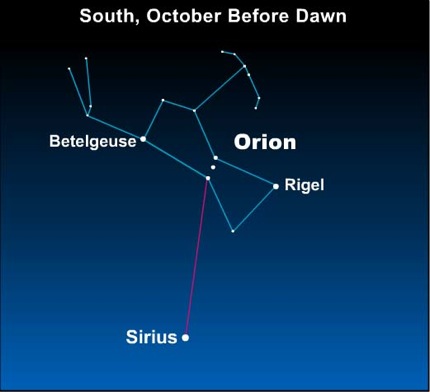
Distance and Size
Sirius is only 8.6 light years away from Earth and is the 7th nearest star to our Solar System. One of the reasons it appears so bright is because it is one of the closest stars to us.
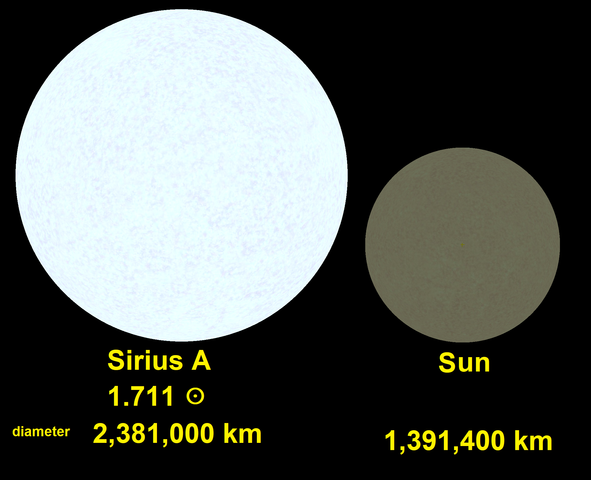
History and Composition Of The Sirius Star
The Sirius system was originally made up of two bluish stars but the more massive one, Sirius B, consumed its resources and became a red giant before shedding its outer layers and collapsing into its current state as a white dwarf around 120 million years ago. When it passed through its red giant phase, the star may have enriched the metallicity of its companion.
It is thought that Sirius A formed during the collapsing of a molecular cloud. After 10 million years, the internal energy generation was derived entirely from nuclear reactions, meaning the core became convective and used the CNO cycle for energy generation.
Sirius B is primarily made out of a carbon-oxygen mixture that was generated by helium fusion in the progenitor star. The outer atmosphere is now almost pure hydrogen, which is the element with the lowest mass.
Sirius Star - Facts About The Brightest Star From Earth - The Planets


Komentar
Posting Komentar