Discovery Alert: ‘Baby’ Planet Photographed in a Ring around a Star for the First Time!
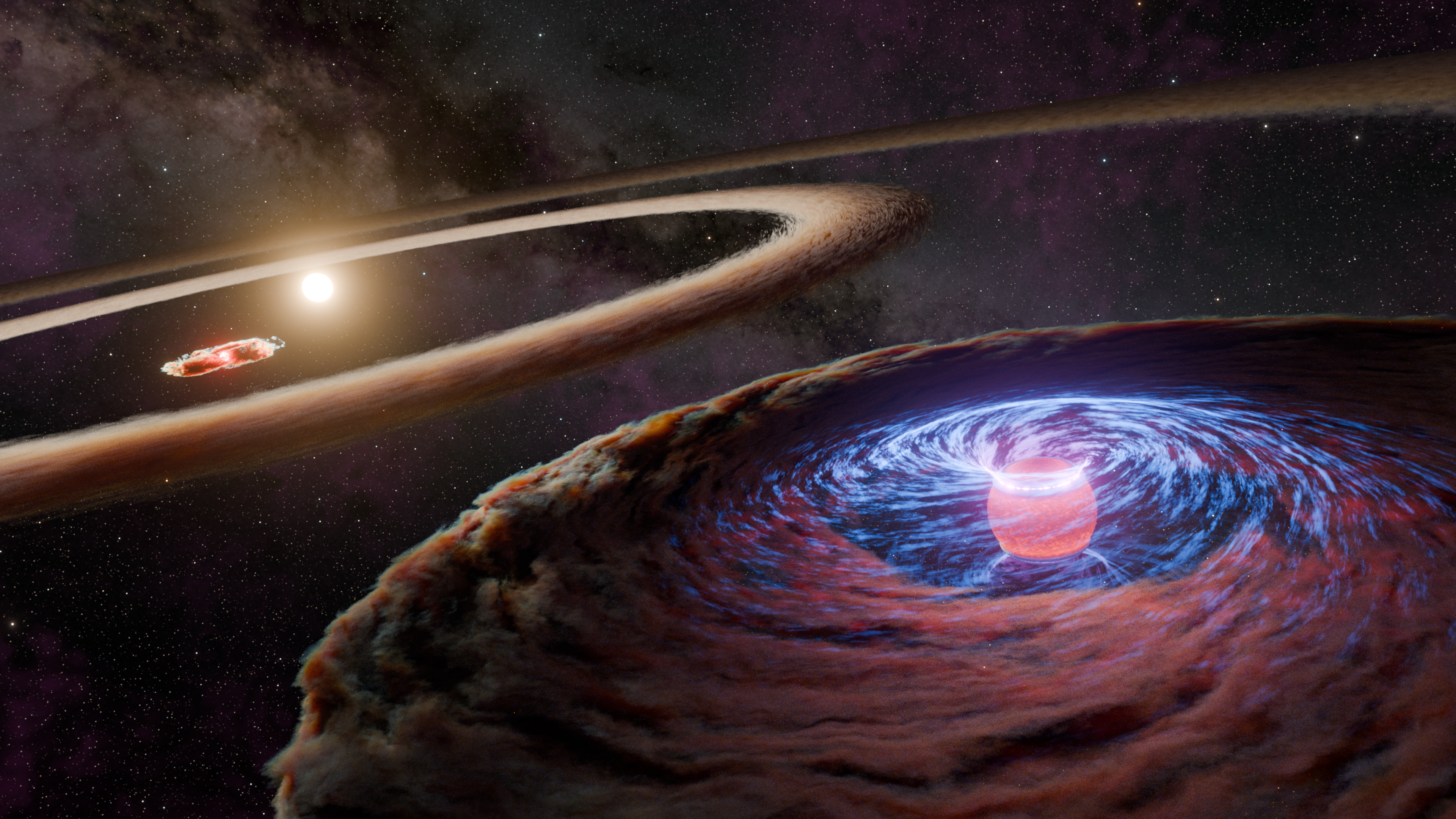
Researchers have discovered a young protoplanet called WISPIT 2b embedded in a ring-shaped gap in a disk encircling a young star. While theorists have thought that planets likely exist in these gaps (and possibly even create them), this is the first time that it has actually been observed.
Researchers have directly detected – essentially photographed – a new planet called WISPIT 2b, labeled a protoplanet because it is an astronomical object that is accumulating material and growing into a fully-realized planet. However, even in its "proto" state, WISPIT 2b is a gas giant about 5 times as massive as Jupiter. This massive protoplanet is just about 5 million years old, or almost 1,000 times younger than the Earth, and about 437 light-years from Earth.
Being a giant and still-growing baby planet, WISPIT 2b is interesting to study on its own, but its location in this protoplanetary disk gap is even more fascinating. Protoplanetary disks are made of gas and dust that surround young stars and function as the birthplace for new planets.
Within these disks, gaps or clearings in the dust and gas can form, appearing as empty rings. Scientists have long suggested that these growing planets are likely responsible for clearing the material in these gaps, pushing and scattering dusty disk material outwards and greeting the ring gaps in the first place. Our own solar system was once just a protoplanetary disk, and it's possible that Jupiter and Saturn may have cleared ring gaps like this in that disk many, many years ago.
But despite continued observation of stars with these kinds of disks, there was never any direct evidence of a growing planet found in one of these ring gaps. That is, until now. As reported in this paper, WISPIT 2b was directly observed in one of the ring gaps around its star, WISPIT 2.
Another interesting aspect of this discovery is that WISPIT 2b appears to have formed where it was found, it didn't form elsewhere and move into the gap somehow.
Fun Facts:
In addition to discovering WISPIT 2b, this team spotted a second dot in one of the other dark ring gaps even closer to the star WISPIT 2. This second dot has been identified as another candidate planet that will likely be investigated in future studies of the system.


Komentar
Posting Komentar